 By
By Dholavira
Dholavira was one of the most remarkable and well-preserved cities of the Indus Valley Civilization, located in the Kutch district of Gujarat, India. Unlike many other Harappan sites, Dholavira is unique for its advanced water conservation system and distinct city planning. It flourished between 3000 BCE and 1500 BCE, making it one of the longest continuously inhabited sites of the civilization.
Location & Significance
Dholavira is situated on the arid island of Khadir Bet in the Rann of Kutch, between two seasonal streams, Mansar and Manhar. Despite being in a dry region, the city thrived due to its innovative water management techniques.
Highlights:
- Located in Rann of Kutch (Gujarat)
- Surrounded by seasonal rivers
- Adapted to a dry and harsh climate
- Important trade and cultural center
Urban Planning & Structure
Dholavira showcases a unique and highly organized urban design. Unlike other Harappan cities, it was divided into three main parts: the citadel, the middle town, and the lower town. The city was fortified with massive stone walls, which is a distinctive feature compared to the brick structures found elsewhere.
Highlights:
- Division into citadel, middle town, and lower town
- Use of stone in construction
- Strong fortification walls
- Well-planned streets and layouts
Water Management System (Special Feature)
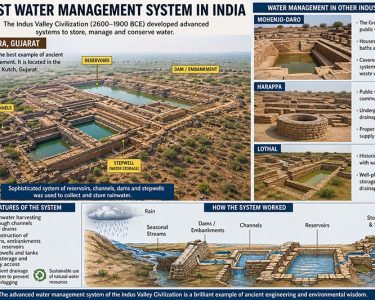
Dholavira is especially famous for its advanced water conservation system, which is considered one of the most sophisticated in the ancient world.
Highlights:
- Large reservoirs and water tanks
- Rainwater harvesting system
- Dams and channels to store water
- Efficient use of seasonal streams
Houses & Daily Life
The houses in Dholavira were built with stone and mud bricks and were designed according to social status. The presence of open spaces, courtyards, and proper drainage indicates a comfortable lifestyle.
Highlights:
- Stone and mud-brick houses
- Courtyards and open spaces
- Organized living structure
- Basic drainage system
Economy & Trade
The economy of Dholavira was based on agriculture, animal husbandry, and trade. Due to its location, it acted as a link between inland and coastal trade routes.
Highlights:
- Agriculture and livestock rearing
- Trade with other Harappan cities
- Bead-making and craftsmanship
- Strategic trade location
Religion & Beliefs
Like other Harappan sites, religious practices in Dholavira were nature-based. Although no large temples have been found, symbols and artifacts suggest spiritual beliefs connected to fertility and nature.
Highlights:
- Nature-based worship
- Possible fertility symbols
- Lack of large temples
- Community-based rituals
Art, Culture & Script
Dholavira has provided important evidence of Harappan culture, including inscriptions and artifacts. One of the most unique discoveries is a large signboard with Harappan script.
Highlights:
- Harappan script inscriptions
- Unique signboard discovery
- Pottery and ornaments
- Skilled craftsmanship
Decline of Dholavira
Dholavira declined around 1500 BCE, likely due to environmental changes and water scarcity.
Possible Causes:
- Climate change and drought
- Decrease in water availability
- Decline in trade
- Harsh environmental conditions
Conclusion
Dholavira stands out as one of the most innovative cities of the Indus Valley Civilization. Its advanced water management system, unique city planning, and adaptation to a harsh environment demonstrate the intelligence and resilience of its people. Today, it is recognized as a UNESCO World Heritage Site and continues to be a key source of knowledge about ancient Indian civilization.