 By
By Introduction
The Indus Valley Civilization was one of the world’s earliest and most advanced urban civilizations. It flourished between 2600 BCE and 1900 BCE along the Indus River and its tributaries.
It is also known as the Harappan Civilization, named after the first discovered site, Harappa.
Discovery
The civilization was discovered in the 1920s during archaeological excavations:
- Daya Ram Sahni discovered Harappa
- R. D. Banerji discovered Mohenjo-daro
Major Locations
- Harappa (Pakistan)
- Mohenjo-daro (Pakistan)
- Dholavira (Gujarat, India)
- Lothal (Gujarat, India)
- Kalibangan (Rajasthan, India)
- Rakhigarhi (Haryana, India)
Town Planning
One of the most remarkable features of the civilization was its advanced urban planning:
- Well-planned grid system of roads
- Houses made of baked bricks
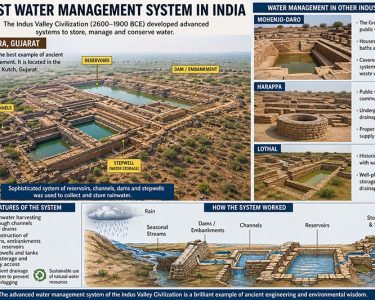
- Proper drainage system in almost every house
- Covered sewage system
- High level of engineering and civic management.
Social Life
- Well-organized and disciplined society
- People engaged in agriculture, trade, and crafts
- Evidence suggests relatively equal social status
- Strong community living system
Economy
- Agriculture was the main occupation
- Crops: wheat, barley, cotton
- Trade with regions like Mesopotamia
- Lothal served as a major port city
Religion
- Worship of nature and fertility
- Mother Goddess was widely worshipped
- Proto-Shiva (Pashupati seal) representation found
- Sacred trees like the Peepal tree
Art and Culture
- Pottery with geometric designs
- Seals with animal figures and symbols
- Bronze sculpture like the famous “Dancing Girl”
- Bead-making and jewelry craftsmanship
Script
- The Indus script is still undeciphered
- Believed to be pictographic in nature
Decline
The decline of the civilization around 1900 BCE is still debated. Possible reasons include:
- Climate change
- River shifts
- Floods or natural disasters
- Decline in trade
Key Features
- One of the earliest urban civilizations
- Advanced drainage and sanitation system
- Strong trade network
- High level of craftsmanship and technology
Conclusion
The Indus Valley Civilization stands as a remarkable example of early human innovation and urban development. Its advanced systems of planning, trade, and culture continue to inspire modern society and historians alike.