 By
By Harappan Civilization
Harappa was one of the प्रमुख urban centers of the Indus Valley Civilization, located near the Ravi River in present-day Pakistan. Discovered in 1921 by Daya Ram Sahni, it gave its name to the entire Harappan Civilization. The city flourished between 2600 BCE and 1900 BCE and is regarded as one of the earliest examples of a well-planned urban settlement. Its location near a river provided fertile land for agriculture and easy trade routes, making it a major center of economic and cultural activity.
Location & Significance
Harappa’s strategic position on the banks of the Ravi River played a crucial role in its development. The fertile plains supported agriculture, while its connectivity enabled trade with distant regions. This geographical advantage helped Harappa grow into a stable and prosperous urban center with strong economic foundations.
Highlights:
- Located near Ravi River
- Fertile agricultural land
- Important trade connections
- Major cultural and economic hub
Urban Planning & Structure
Harappa is widely known for its advanced and systematic urban planning. The city was divided into two main parts: the citadel (upper town) and the lower town. The citadel, built on a raised platform, likely served administrative or public functions, while the lower town consisted of residential areas. Streets were laid out in a grid pattern, intersecting at right angles, showing careful and scientific planning.
Highlights:
- Division into citadel and lower town
- Grid-pattern road system
- Standardized baked bricks
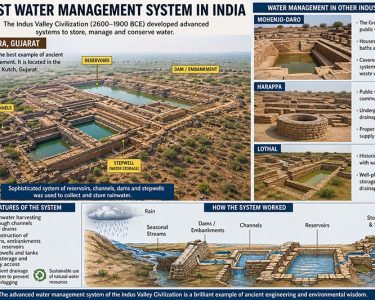
- Advanced drainage and sewage system
Houses & Daily Life
The houses in Harappa were designed for comfort and hygiene. Most houses had multiple rooms, courtyards, and proper ventilation. A notable feature was that many houses had private wells and bathrooms connected to the city’s drainage system, indicating a high standard of living.
Highlights:
- Multi-room houses with courtyards
- Private wells and bathrooms
- Proper sanitation facilities
- Organized and clean lifestyle
Economy & Trade
The economy of Harappa was based on agriculture, trade, and skilled craftsmanship. Farmers cultivated crops like wheat, barley, peas, and cotton. Trade networks extended to distant regions such as Mesopotamia, and standardized weights and measures were used for transactions, showing economic sophistication.
Highlights:
- Agriculture as main occupation
- Trade with Mesopotamia
- Use of seals, weights, and measures
- Skilled crafts like pottery and bead-making
Religion & Beliefs
Religious life in Harappa was closely linked to nature and fertility. Archaeological evidence suggests the worship of a Mother Goddess and a proto-Shiva figure known as Pashupati. Animals and trees were also considered sacred, indicating a deep connection with nature.
Highlights:
- Worship of Mother Goddess
- Proto-Shiva (Pashupati)
- Sacred animals and trees
- Nature-based beliefs
Art, Culture & Script
Harappans were highly skilled in art and craftsmanship. They produced terracotta figurines, pottery, seals, and jewelry. The famous bronze statue known as the “Dancing Girl” reflects their artistic excellence. The script used by them remains undeciphered, which continues to be a mystery.
Highlights:
- Seals with animal motifs
- Terracotta figurines
- Jewelry and bead-making
- Undeciphered script
Decline of Harappa
Harappa began to decline around 1900 BCE, and the exact reasons are still debated. Environmental changes and disruptions in trade are considered major factors behind its downfall.
Possible Causes:
- Climate change
- River shifting
- Floods and natural disasters
- Decline in trade networks
Conclusion
Harappa stands as a remarkable example of early urban civilization, showcasing advanced planning, economic strength, and cultural richness. Its well-organized systems and innovations highlight the intelligence and capabilities of ancient societies, making it one of the most important archaeological discoveries in history.