 By
By Oldest Water Management System in India
The oldest known and most advanced water management system in India dates back to the Indus Valley Civilization (around 2600–1900 BCE). This ancient civilization demonstrated remarkable knowledge of engineering, urban planning, and environmental adaptation. Despite living thousands of years ago, its people developed systems to store, manage, and efficiently use water, especially in regions with limited rainfall. These early innovations laid the foundation for sustainable water management practices in the Indian subcontinent.
Dholavira – The Most Advanced Example
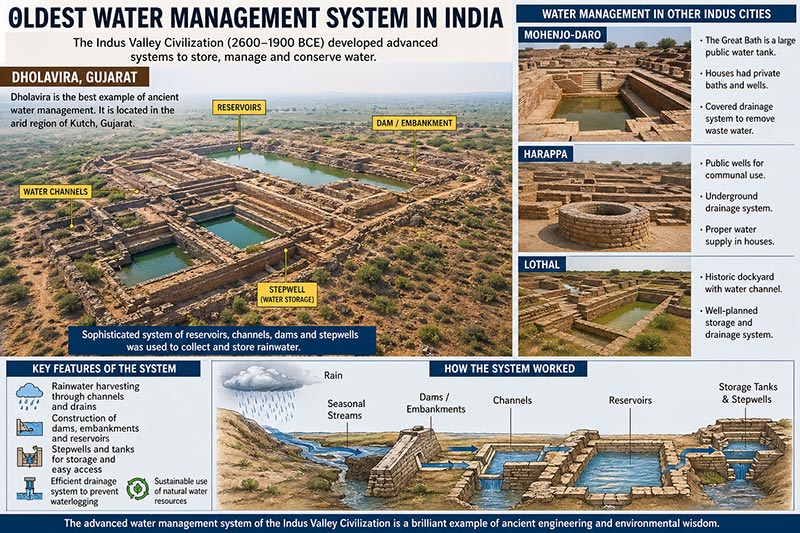
Dholavira is considered the finest example of ancient water management in India. Located in the dry and desert-like region of the Rann of Kutch in Gujarat, Dholavira faced severe water scarcity. To overcome this challenge, its inhabitants designed a highly sophisticated system to collect and store rainwater. They built massive reservoirs, step-like water tanks, and channels to direct rainwater into storage areas. Dams and embankments were constructed across seasonal streams like Mansar and Manhar to control water flow. This system ensured that water was available throughout the year, even during dry periods, showing an extraordinary level of planning and environmental understanding.
Water Management in Other Indus Cities
Water management was not limited to Dholavira; other major cities of the civilization also displayed advanced systems. In Mohenjo-daro, almost every house had access to water through wells, and there was a well-developed drainage system to remove wastewater. The famous Great Bath is an example of a large public water structure used for ritual or community purposes. Similarly, Harappa had underground drainage systems, public wells, and organized water distribution, ensuring hygiene and cleanliness in urban life. These cities highlight how water management was integrated into daily living and urban planning.
Key Features of the System
The water management systems of the Indus Valley Civilization were highly advanced for their time. They were based on scientific planning and efficient use of natural resources. Rainwater harvesting was widely practiced, and water was stored in large reservoirs and tanks. Drainage systems were carefully designed to prevent waterlogging and maintain sanitation. The use of standardized construction techniques ensured durability and efficiency. These systems were not only practical but also sustainable, allowing cities to thrive in challenging environments.
Importance and Legacy
The ancient water management systems of India are important because they show that early civilizations had a deep understanding of nature and sustainability. These systems helped people survive in both fertile and arid regions, supporting agriculture, trade, and urban life. Even today, many modern water conservation methods, such as rainwater harvesting and reservoir storage, are inspired by these ancient practices. The knowledge developed during this period continues to influence environmental planning and resource management.
Conclusion
The oldest water management system in India, developed during the Indus Valley Civilization, stands as a remarkable achievement in human history. Cities like Dholavira, Mohenjo-daro, and Harappa demonstrate how ancient societies successfully managed water through innovation, planning, and sustainability. These systems not only supported large urban populations but also reflected a deep respect for natural resources. Even after thousands of years, they remain a source of inspiration for modern engineering and environmental conservation.